
What Do the Numbers on Your Tyres Mean? Australian Tyre Size Guide
Have you ever looked at the side of your car tyre and wondered what all those numbers and letters actually mean? You might see something like 205/55 R16 91V printed on the rubber. To most drivers, it looks like a random combination of numbers, but every character provides useful information about the tyre's size, construction and performance specifications.
Understanding tyre numbers is particularly important when you're buying replacement tyres. Two tyres may look similar, yet have different dimensions, load capacities or speed ratings that make them unsuitable for the same vehicle. Whether you drive a small hatchback, family sedan or SUV, knowing how to read your tyre size can help you make a more informed decision before purchasing new tyres.
In this Australian tyre size guide, we'll explain what the numbers on your tyres mean, where to find the correct specifications for your car and what you should check before replacing your tyres. If you're looking for professional tyre fitting or replacement tyres in Sydney, Mathews Tyres & Mechanical operates from 43 Ninth Ave, Campsie NSW 2194, providing tyre and mechanical services for motorists throughout Campsie and surrounding suburbs.
What Do the Numbers on a Car Tyre Mean?
The numbers and letters on your tyre's sidewall identify important technical specifications. They tell you the tyre's width, profile, construction, wheel diameter, load rating and speed rating. For example, consider this common tyre size:
205/55 R16 91V
Here's what each part represents:
| Marking | Meaning | Explanation |
|---|---|---|
| 205 | Tyre width | Nominal section width of 205 millimetres |
| 55 | Aspect ratio | Sidewall height is 55% of the tyre's width |
| R | Construction | Radial tyre construction |
| 16 | Wheel diameter | Designed for a 16-inch wheel rim |
| 91 | Load index | Rated load capacity of 615 kg per tyre |
| V | Speed rating | Rated maximum speed of 240 km/h under specified conditions |
These markings follow standardised tyre designation conventions used by tyre manufacturers around the world. They allow tyre shops and motorists to identify tyres that may be suitable for a particular vehicle. However, matching the numbers on an existing tyre isn't always enough. You should also check the vehicle manufacturer's recommended specifications, especially if the wheels or tyres have previously been changed.
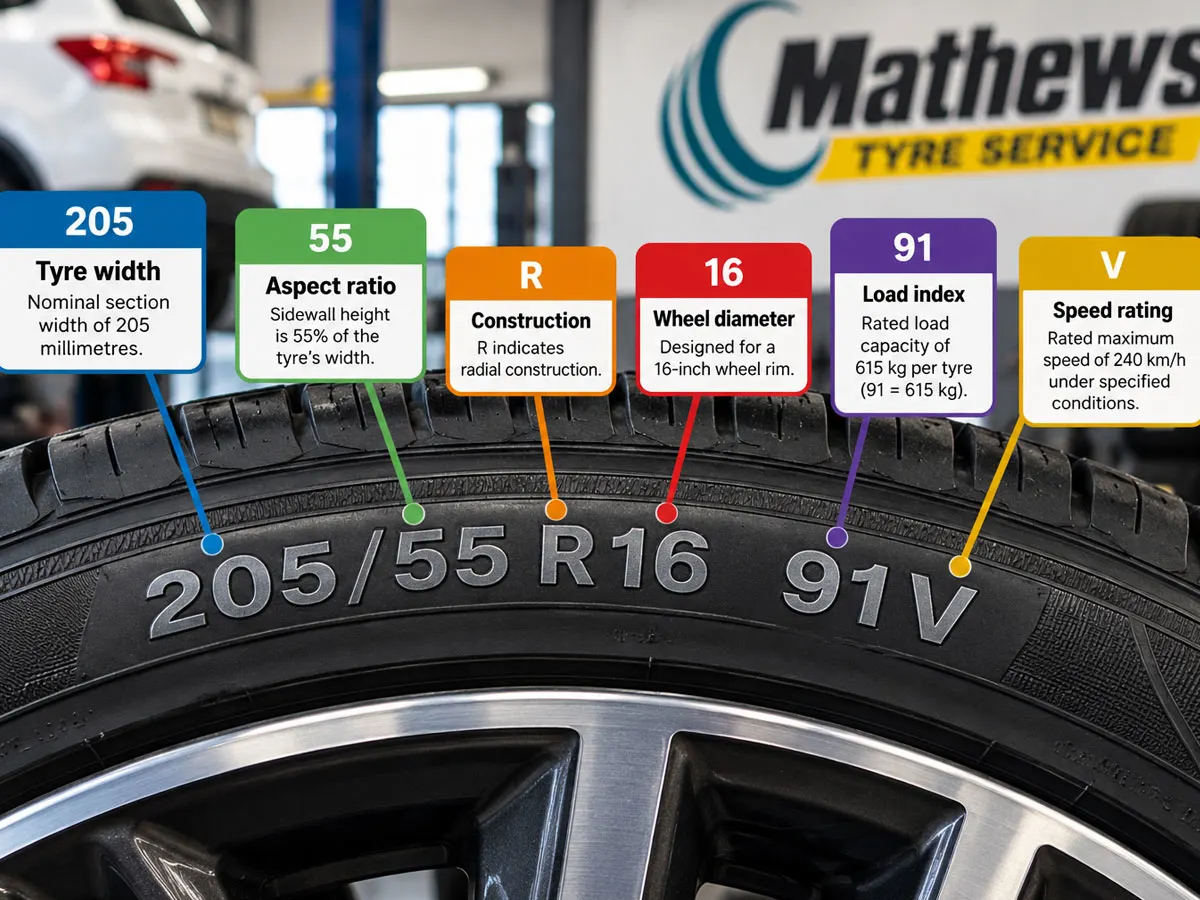
How to Read Your Tyre Size: Step-by-Step Explanation
Let's examine each part of a tyre size in more detail.
1. What Does 205 Mean on a Tyre?
The first number represents the tyre's nominal section width in millimetres. In the example 205/55 R16, the number 205 indicates a nominal section width of 205 mm. Section width is measured across the tyre between its sidewalls under specified measuring conditions. It isn't simply the width of the tread pattern touching the road.
You may encounter different widths, including 185, 195, 205, 215, 225 and 235 mm. A wider tyre is not automatically better. Tyre width must suit the vehicle, wheel dimensions and manufacturer requirements. Fitting a tyre that is too wide or otherwise unsuitable may create clearance problems or affect handling.
2. What Does 55 Mean on a Tyre?
The second number is called the aspect ratio, sometimes referred to as the tyre profile. It tells you how tall the sidewall is relative to the tyre's nominal section width. For a 205/55 tyre, the nominal sidewall height is 55% of 205 mm. That works out to approximately 112.75 mm.
It does not mean the sidewall is 55 mm high. The aspect ratio helps explain why tyres of similar widths can look different. A tyre marked 205/65 has a taller nominal sidewall than a 205/45 tyre. Lower-profile tyres generally have shorter sidewalls, while higher-profile tyres have taller sidewalls relative to their widths.
Changes to tyre profile can affect ride comfort, wheel clearance, overall rolling diameter and handling. Always check compatibility before choosing a different profile.
3. What Does R Mean on a Tyre?
The letter R stands for radial construction. Radial tyres use internal reinforcement arranged in a particular way, with the carcass cords running approximately radially from bead to bead. Radial construction is widely used in modern passenger-car tyres.
The letter does not stand for racing, radius or rim. Other construction markings exist, but radial tyres are the most familiar type for modern Australian passenger vehicles.
4. What Does 16 Mean on a Tyre?
The number immediately following the construction letter identifies the wheel rim diameter in inches. For example:
205/55 R16 means the tyre is designed for a wheel rim with a 16-inch bead-seat diameter.
Common passenger-car wheel diameters include 15, 16, 17, 18 and 19 inches, although other sizes are available. The tyre and rim diameters must match. A tyre designed for a 16-inch wheel cannot be fitted correctly to a 17-inch wheel. If you're considering larger alloy wheels, the replacement tyre dimensions and other specifications must remain suitable for the vehicle and comply with applicable requirements.
5. What Does 91 Mean on a Tyre?
The number after the tyre size is the load index. A load index represents the maximum load a correctly used tyre is rated to support under specified conditions. For example, load index 91 corresponds to 615 kg per tyre. That does not mean your vehicle can automatically carry four times this amount as payload. The vehicle's own axle, gross mass and other limits still apply.
Different tyres of the same dimensions can have different load indexes. That's why tyre width, profile and rim diameter aren't the only details that matter when selecting replacements.
6. What Does V Mean on a Tyre?
The final letter is the speed rating, also known as the speed symbol. In the example 205/55 R16 91V, the letter V represents a rated maximum speed of 240 km/h under specified conditions. The speed rating is a technical capability classification, not permission to drive at that speed.
Australian speed limits always apply. Your vehicle's requirements and applicable tyre regulations determine which speed ratings are appropriate.
Tyre Load Index Explained: What Do the Numbers Mean?
The load index is particularly important because it indicates how much weight a tyre is designed to support. A higher load-index number generally corresponds to a higher rated carrying capacity. Here are several common examples:
| Load index | Rated maximum load per tyre |
|---|---|
| 88 | 560 kg |
| 89 | 580 kg |
| 90 | 600 kg |
| 91 | 615 kg |
| 92 | 630 kg |
| 94 | 670 kg |
| 95 | 690 kg |
| 98 | 750 kg |
| 100 | 800 kg |
When buying replacement tyres, it's important to choose a load rating that meets your vehicle's requirements. For vehicles operating in NSW, replacement tyres must comply with applicable vehicle standards, including load-rating requirements.
Selecting a tyre with a lower load capacity than permitted may create safety and compliance problems. Remember that the load index applies to the tyre under its specified operating conditions. It does not replace the vehicle manufacturer's load limits.
Can You Fit Tyres With a Higher Load Index?
In many circumstances, a tyre with a higher load index may be suitable, provided the complete tyre specification is compatible with the vehicle and wheel. However, a higher rating doesn't automatically mean the tyre is the best choice. Construction, load characteristics, inflation requirements and manufacturer recommendations still matter.
For accurate advice, confirm the complete tyre specification rather than comparing load-index numbers alone.
Tyre Speed Ratings Explained
The speed symbol is another important tyre marking. Different letters correspond to different rated maximum speeds. Some common passenger-car speed symbols include:
| Speed rating | Rated maximum speed |
|---|---|
| S | 180 km/h |
| T | 190 km/h |
| H | 210 km/h |
| V | 240 km/h |
| W | 270 km/h |
| Y | 300 km/h |
These are classification ratings, not recommended road speeds. Speed ratings are assigned through specified tyre testing and operating criteria. When replacing tyres, check the speed rating required for your particular vehicle and the applicable Australian and NSW requirements.
Don't assume that a lower speed rating is acceptable simply because you never drive near the tyre's maximum rated speed. Tyre suitability involves more than normal road speed.
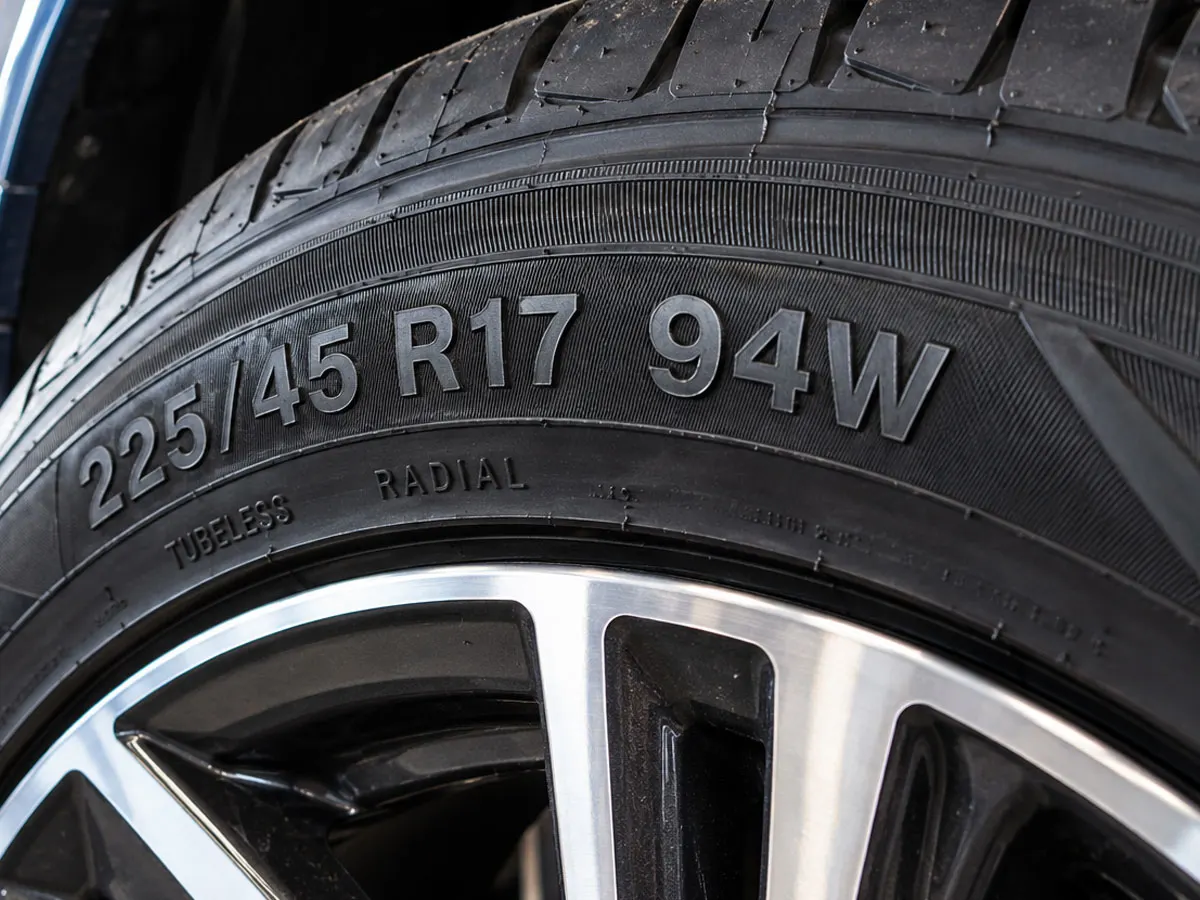
Where Can You Find the Correct Tyre Size for Your Car?
You can usually find tyre size information in three places.
1. On the Tyre Sidewall
Look at the outer side of one of your existing tyres. The tyre size is generally moulded into the rubber in a format similar to:
225/45 R17 94W
The markings are usually easy to identify once you know what you're looking for. However, the tyres currently fitted to the vehicle are not always the correct original specification. This is particularly important when purchasing a used car or a vehicle with aftermarket wheels.
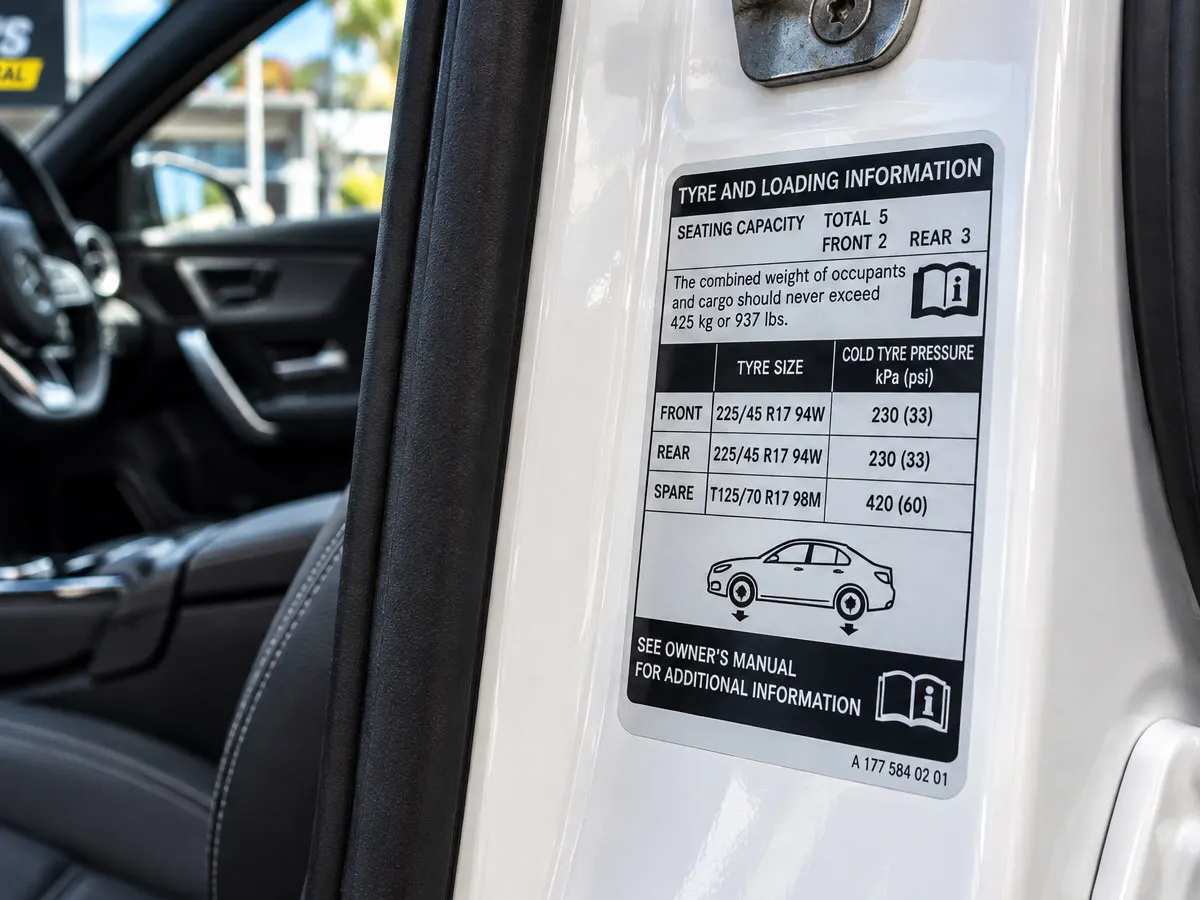
2. On Your Vehicle's Tyre Placard
The vehicle tyre placard provides important manufacturer-approved tyre information. It is commonly found around the driver's door opening. Depending on the vehicle, it may also be located inside the fuel flap, glove box or another specified position.
The placard may include:
- Recommended tyre sizes
- Suitable wheel specifications
- Load and speed information
- Recommended cold inflation pressures
- Different pressure recommendations for various loads
For tyre replacement, the vehicle placard is an important reference point.
3. In Your Vehicle Owner's Manual
The owner's manual may provide details about approved tyre sizes, recommended pressures and other tyre-related requirements. Some vehicles have different approved tyre and wheel combinations depending on the model variant. If your current tyres and the manufacturer's information appear inconsistent, have the specifications checked before buying replacements.
Can You Put Different Size Tyres on Your Car?
Sometimes, but you should never assume a different tyre size will fit or comply with applicable vehicle standards. Changing tyre dimensions can affect:
- Overall rolling diameter
- Speedometer readings
- Wheel and body clearance
- Steering and handling
- Ride comfort
- Load capacity
- Electronic vehicle systems
- Compliance with NSW modification requirements
A tyre with a wider section width may require a different wheel width. Changing the aspect ratio may alter the overall diameter even if the wheel size stays the same. Similarly, fitting larger alloy wheels may require a different tyre profile to maintain an appropriate overall tyre diameter.
Some vehicles have approved alternative tyre sizes, while others have stricter requirements. If you're considering a change from the manufacturer's original tyre dimensions, speak with a qualified tyre professional and check the applicable NSW standards before purchasing.
What Is the Difference Between 205/55 R16 and 205/60 R16?
These tyre sizes share the same nominal width and rim diameter, but their profiles are different. Both tyres have a nominal section width of 205 mm and are intended for 16-inch wheel rims. However:
- 205/55 R16 has a nominal sidewall height of approximately 112.75 mm.
- 205/60 R16 has a nominal sidewall height of approximately 123 mm.
That means the 205/60 tyre has a taller sidewall and a larger nominal overall diameter. The difference can influence the rolling circumference and speedometer reading. It can also affect clearance and vehicle behaviour. These tyres should not be treated as interchangeable without checking compatibility.
The same principle applies to other sizes that look almost identical. Small changes in the numbers can have meaningful consequences.
What Does XL Mean on a Tyre?
XL usually means Extra Load. An XL tyre is designed to support a higher load than a standard-load tyre of comparable dimensions under its specified operating conditions. You may also see markings such as Reinforced, depending on the tyre.
These tyres can have different load and inflation characteristics from standard-load alternatives. XL does not mean that the tyre is intended exclusively for SUVs or off-road driving. Likewise, an SUV does not automatically require any tyre marked XL.
The correct specification depends on the vehicle manufacturer and the tyre's complete characteristics. If your vehicle requires an extra-load tyre, replacing it with an unsuitable standard-load version may not meet the necessary requirements.
What Do P, LT and C Mean on Tyres?
Some tyres include letters identifying their intended application or construction category.
P — Passenger
P is used in certain tyre designation systems to indicate passenger-vehicle tyres. It commonly appears in specifications such as P215/65 R16.
LT — Light Truck
LT generally identifies a light-truck tyre designation. These tyres may have different construction and load characteristics from ordinary passenger-car tyres. They are commonly associated with certain commercial vehicles and four-wheel drives.
C — Commercial
In relevant tyre designations, C often indicates a commercial or van tyre. For example, a van tyre may have specifications that differ from those of a passenger-car tyre with similar dimensions. It's important not to assume that passenger, light-truck and commercial tyres are interchangeable merely because their width and rim diameter match.
Vehicle load requirements and tyre construction must also be considered.
How Do You Read the Manufacture Date on a Tyre?
Tyres carry manufacturing identification markings that can help establish when they were produced. On tyres using the familiar four-digit date-code format, the final four numbers indicate the production week and year. For example:
2424
This indicates manufacture during the 24th week of 2024. The manufacturing date marking may be visible on only one side of the tyre. If you can't locate it, the marking may be on the sidewall facing the vehicle.
Does an Older Manufacture Date Mean a Tyre Is Unsafe?
Not automatically. Tyre condition depends on a range of factors, including age, storage, exposure, use and maintenance. A tyre can suffer damage or deterioration before its tread is completely worn. Conversely, age alone doesn't reveal every aspect of a tyre's condition.
Signs that deserve attention include:
- Sidewall cracking
- Bulges
- Cuts
- Unusual tread wear
- Persistent pressure loss
- Visible deterioration
If you're concerned about the age or condition of your tyres, arrange a professional inspection. For more information about tyre replacement, explore the other articles in our tyre care and maintenance blog.
Does Tyre Size Affect Tyre Pressure?
Tyre size and tyre pressure are related to tyre fitment and operation, but the tyre size alone does not tell you the correct pressure for your vehicle. You should not assume that all 205/55 R16 tyres require the same PSI. The appropriate cold tyre pressure depends on the vehicle manufacturer's recommendations, the tyre specification and operating conditions.
Your tyre placard is the starting point. The maximum pressure printed on the tyre sidewall is not necessarily the recommended pressure for everyday driving. Incorrect tyre pressure can contribute to uneven wear, changes in handling and unnecessary fuel consumption.
Check pressures regularly and follow the appropriate manufacturer guidance.
How Do You Know Which Tyres to Buy?
When it's time to buy new tyres, begin by confirming the complete required specification. That means checking more than just the tyre width. Use this checklist:
- Confirm the approved tyre size. Check the vehicle placard or manufacturer information.
- Check the load index. Ensure the replacement meets the necessary load requirement.
- Check the speed rating. Confirm the appropriate rating for the vehicle and applicable regulations.
- Consider the tyre's intended use. Think about your normal driving conditions.
- Check for special requirements. These may include extra-load, run-flat or vehicle-specific tyres.
- Consider the condition of the other tyres. Some vehicles, particularly certain all-wheel-drive models, have additional requirements regarding differences in tyre size or wear.
- Arrange appropriate fitting and balancing. Correct fitting is important after selecting a suitable tyre.
Should You Choose Budget or Premium Tyres?
Price is one factor, but it shouldn't be the only consideration. Tyres can differ in wet-weather grip, noise, wear characteristics, rolling resistance and other performance attributes. The most suitable choice depends on your vehicle, driving conditions, requirements and budget.
A well-matched tyre that meets the vehicle's specifications is more important than choosing based purely on appearance or brand recognition.
Should You Replace Two or Four Tyres?
That depends on the condition and specifications of the existing tyres and the vehicle manufacturer's guidance. Replacing tyres in pairs may be appropriate in some situations. However, certain vehicles have additional restrictions concerning tread-depth differences, tyre matching and drivetrain operation.
If you're replacing fewer than four tyres, confirm the correct tyre positioning and compatibility with a professional.
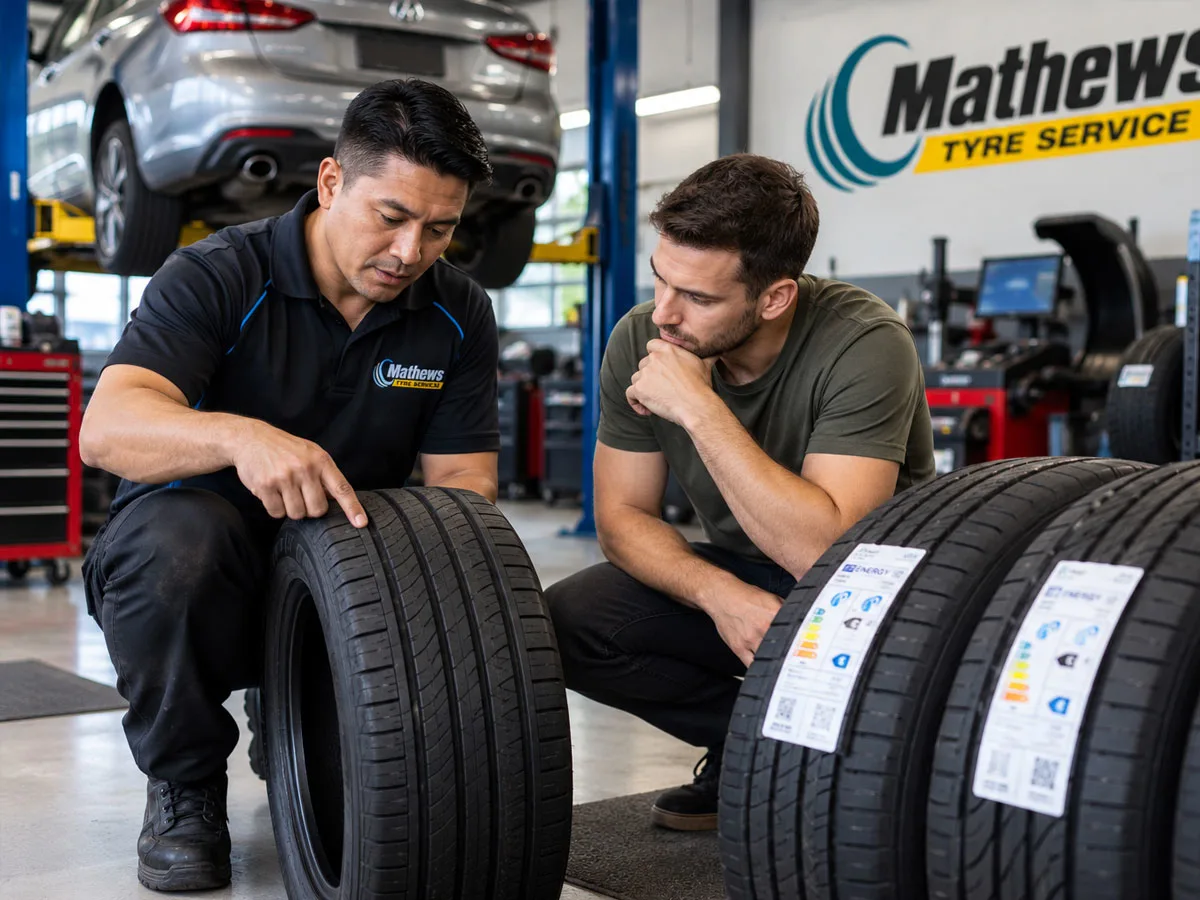
Professional Tyre Replacement and Fitting in Campsie
If you're unsure what the tyre numbers on your car mean, you don't need to work everything out before contacting a tyre shop. Mathews Tyres & Mechanical can help motorists identify their tyre requirements and discuss suitable replacement options.
Our workshop is located at:
43 Ninth Ave, Campsie NSW 2194
We provide tyre replacement, fitting, wheel balancing, wheel alignment, puncture repairs, alloy wheels and mechanical services. We welcome customers from Campsie and neighbouring suburbs, including Canterbury, Belmore, Belfield, Lakemba, Earlwood, Clemton Park and Croydon Park.
When enquiring about replacement tyres, it helps to have your vehicle make, model, year and current tyre markings available. If the tyres currently fitted to your vehicle are not the original specification, mention this so compatibility can be checked.
For motorists who have noticed vibration, steering problems or irregular tyre wear, it may also be worth discussing whether balancing, wheel alignment or another inspection is appropriate. Visit Mathews Tyres & Mechanical for further information about our services.
Frequently Asked Questions About Tyre Sizes and Numbers
What do the numbers 205/55 R16 mean on a tyre?
The number 205 indicates the tyre's nominal width in millimetres. The number 55 is the aspect ratio, meaning the sidewall height is 55% of the width. R indicates radial construction, and 16 means the tyre fits a 16-inch wheel rim.
What does 91V mean on a tyre?
The number 91 is the load index, corresponding to a rated maximum load of 615 kg per tyre under specified conditions. V is the speed rating, corresponding to 240 km/h. The tyre must still meet your vehicle's specifications and applicable requirements.
Where can I find my car's tyre size?
You can find the size on the tyre sidewall. You should also check the vehicle's tyre placard, commonly located around the driver's door opening, or consult the owner's manual.
Can I fit 205/60 R16 tyres instead of 205/55 R16?
Not automatically. These tyres have different nominal sidewall heights and overall diameters. You need to confirm whether the alternative size is approved, mechanically compatible and compliant with the relevant standards.
What does R17 mean on a tyre?
R means radial construction, while 17 indicates that the tyre is designed for a 17-inch wheel rim. It does not describe the tyre's width or complete overall diameter.
What does XL mean on a car tyre?
XL generally means Extra Load. It identifies a tyre designed for higher load capability than a comparable standard-load tyre under specified conditions. It should be selected according to your vehicle's requirements.
What is the difference between tyre size and tyre pressure?
Tyre size describes physical dimensions and construction. Tyre pressure is the amount of air pressure inside the tyre, usually expressed in PSI or kPa. The correct inflation pressure should be determined using the vehicle manufacturer's recommendations.
Can I use different tyre brands on the same car?
Brand differences alone do not determine suitability. Tyre size, construction, load rating, speed rating, tread condition and vehicle manufacturer requirements all matter. Some vehicles require closely matched tyres, particularly across driven axles. Seek professional advice before mixing tyres.
Does a higher tyre speed rating mean better performance?
Not necessarily. Speed rating is a technical capability classification. It does not, on its own, establish overall grip, ride comfort, wet braking performance or suitability for your vehicle.
How do I find the age of my tyres?
Look for the tyre's manufacturing date code. In the standard four-digit week-and-year format, a code such as 2424 indicates manufacture during the 24th week of 2024. The complete date marking may be visible on only one sidewall.
How do I know if my replacement tyres are the correct size?
Check your vehicle's tyre placard and manufacturer specifications, including the approved size, load index, speed rating and any special requirements. If you have aftermarket wheels, confirm their compatibility as well.
Where can I get replacement tyres fitted near Campsie?
Mathews Tyres & Mechanical provides tyre fitting and related services from 43 Ninth Ave, Campsie NSW 2194. Contact the workshop to discuss tyre specifications and replacement options for your vehicle.
Need Help Choosing the Right Tyres?
Understanding tyre numbers is useful, but you don't have to become a tyre expert to make a suitable purchase. Whether you're comparing replacement tyre sizes, checking load and speed ratings or considering different wheels, choosing tyres that meet your vehicle's requirements is essential.
At Mathews Tyres & Mechanical in Campsie, we can help you discuss your tyre requirements and arrange the relevant services.
Mathews Tyres & Mechanical43 Ninth Ave, Campsie NSW 2194
Contact Mathews Tyres to ask about replacement tyres, fitting, balancing or wheel alignment for your vehicle.